

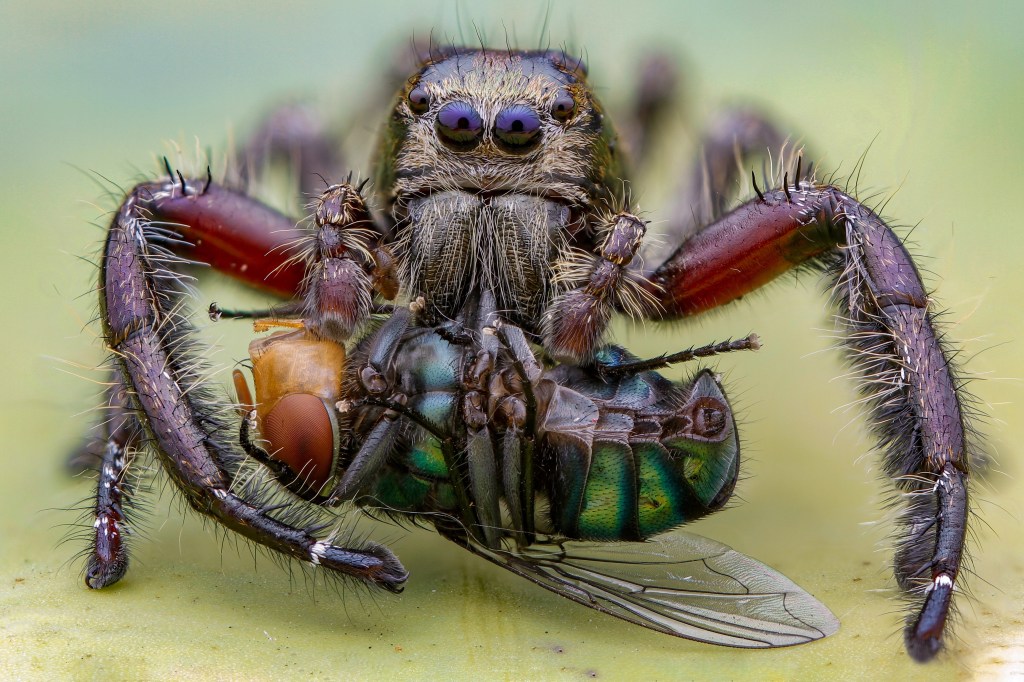

An invasive spider is making the news as it rapidly spreads across the U.S. The Joro spider came from East Asia via shipping containers. If you live in Georgia, where the spider has been prevalent, mark your calendar for the 5th Annual Joro Spider Spotting Contest set for October 12.
Reminds us of the nursery rhyme we all learned as kids. Little Miss Muffet was frightened away by the spider that sat down beside her.
She isn’t alone. The fear of spiders is one of the most common phobias worldwide. Do you sweat, tremble, feel nauseous, or faint when you spot a spider? That’s a clue you have arachnophobia. Fear of snakes is second. And, close behind, glossophobia, fear of public speaking. Take a big breath!
Giggled at a National Geographic article headlined: “Everything you think you know about spiders is wrong. They’re not attracted to your body lotion. They don’t crawl in your mouth at night. In fact, they want nothing to do with you.” Spiders are a diverse group with over 47,000 species. But don’t worry; very few have the venom to kill a human. In fact, they benefit humans by acting as a natural pest control, eating mosquitoes, flies, and various bugs.
Fear of spiders has instigated internet hoaxes disguised as news stories. One alleged that a deadly, exotic spider was found lurking under toilet seats in airports and airplanes.
Speaking of airports, be very careful if you travel to Australia. It gets the prize for hosting four of the ten top venomous spiders. If bitten by the Australian Funnel-web spider, please check into a hospital. ASAP. The creepy female Australian Redback spider slimes its prey to immobilize it. The Redback can’t eat us, but it’s bite is highly venomous and can cause extreme pain.
It is important not to squish spiders. It’s messy and unattractive for your shoes and carpets. But, more importantly, squashing a female may release dozens of baby spiders if she’s carrying eggs. Some spider species eat other spiders, so when you kill one, you’re potentially tipping the balance in favor of the bad guys. Also, relocating an indoor spider to the outdoors is a death sentence. It can’t survive. But you can absolve yourself of its death!
Spiders have no emotions. They will never like you, even if you save them from the bathtub or shower. They are not really fans of water since most will drown. Well, some do make air bubbles on their water-repellent hairs and survive for a surprising amount of time.
Spiders have long been found in legends, myths, and superstitions. The Spider Woman in Navajo history taught humans how to weave. The goddess Athena is said to have challenged Arachne, a dyer’s daughter, to a weaving competition. Athena wove a tapestry depicting the majesty of the gods, while Arachne wove a masterpiece illustrating the various flaws and love affairs of the deities. Arachne’s impressive work caused Athena to fly into a rage and transform Arachne into a spider. This myth is the basis for the scientific term for spiders, Arachnids, as well as arachnophobia, describing the fear of spiders.
In China, spiders are an omen of good luck. They are considered highly auspicious and are often called “happy insects.” Wait! No, they are not insects. Spiders have eight legs; insects have six. Folk wisdom suggests that seeing a spider in the morning brings happiness, while spotting one in the evening represents growing wealth. And, no surprise, during the Middle Ages they were wrongly blamed for transmitting the bubonic plague.
So, our Wrinkled Wisdom for today? If the grandkids want a pet spider, many recommend tarantulas. Huh? Guess they are easy to maintain and fun to observe. Just don’t pick them up! Personally, we prefer dogs and cats. Spiders hate some scents. Spray the house with lavender or peppermint if they are a bother. Horse chestnuts, surprisingly, act as a natural spider repellent. And, remember, seeing a spider isn’t the biggest problem. It’s when it disappears.

enjoyed reading your research!
what’s your next topic?
LikeLike